
The Tests Were Normal. The Nerve Damage Was Real.
The numbness, the unsteady balance, the fear of falling, the burning that’s worse at night — they’re real. Whether you’ve been told it’s “idiopathic,” that it’s “just age,” or that it’s something to manage with gabapentin and live with, “we don’t know why” is not the same as “there’s nothing to find.”
Most neuropathy has a cause the standard workup never looked for — and even once that cause is corrected, the nerve itself still has to heal. Both halves matter. We do both.
Start Your Functional Medicine Evaluation
Call (602) 864-0304
“Idiopathic” Means We Haven’t Found It — Not That There’s Nothing to Find
Your EMG and nerve conduction study confirmed the damage is real. Then the routine labs — blood sugar, B12, thyroid, kidney, a complete blood count — came back “normal,” so you were told the cause is unknown, probably aging, and the plan is to dull the pain with gabapentin or pregabalin. Here’s the problem with that: “normal” on a standard panel and “optimal for nerve health” are not the same threshold — and that panel leaves out most of the things that actually injure peripheral nerves.
A drug like gabapentin can quiet the pain signal. It does nothing about what’s damaging the nerve, and nothing to help the nerve repair. If the burning is a little better but the numbness, the balance, and the steady progression aren’t — that’s the tell. The driver is still active, and the nerve is still waiting for the conditions it needs to heal.
Neuropathy Is Two Problems. Most Clinics Treat One.
Think of it like a house fire. Functional medicine puts out the fire. Hyperbaric oxygen and red light therapy rebuild the house. Do only one, and you never get all the way back.
Something is injuring the nerve. Find it and correct it — the metabolic driver, the deficiency, the inflammation, the gut — and you stop the damage. This is the functional-medicine work, and for most patients it’s where the real cause has been hiding all along. But correcting the cause doesn’t undo damage that’s already done.
Damaged nerve has to heal or regrow, and on its own that process is slow — sometimes too slow, and in some patients it has nearly stalled. This is where hyperbaric oxygen and red light therapy become essential: they supply the oxygen, circulation, and cellular energy repair requires — speeding up the healing the body is doing slowly, or jump-starting it where it had stopped.
inflammation
deficiencies
gut
Normal Labs. Real Damage. A Different Answer.
A real patient story from our Phoenix clinic. Name changed to protect privacy.
“Ron,” 68, came in after five years of numbness, burning, and tingling that started in his toes and crept up both feet and into his lower legs. His balance was going, and he’d started worrying about falling on uneven ground.
His workup had been thorough — EMG and nerve conduction confirmed peripheral neuropathy, and the routine labs (blood sugar, B12, thyroid, kidney, CBC) all came back normal. With no cause found, he was told it was idiopathic, likely just age-related, and given gabapentin, then pregabalin. The burning dulled a little. Nothing else changed.
A deeper workup told a different story. His A1c was normal — but his fasting insulin, HOMA-IR, and triglyceride-to-HDL ratio showed clear insulin resistance, metabolic nerve damage already underway years before it would show up as diabetes. On top of that: a functional B12 insufficiency hiding behind a “normal” level, low vitamin D and magnesium, a low omega-3 index, chronic low-grade inflammation, gut dysbiosis, and a gluten sensitivity he’d never connected to anything. Not aging. A stack of treatable problems no one had looked for.
Phase one stopped what was damaging his nerves. Phase two gave them what they needed to actually heal. Neither one alone would have gotten him there.
This describes one patient’s experience. Individual results vary. Functional medicine, hyperbaric oxygen, and red light therapy are used here as part of an individualized plan, and hyperbaric oxygen and red light are supportive, off-label uses for neuropathy. Always coordinate any medication changes with your prescribing physician.
What a Standard Neuropathy Workup Leaves Out
When a patient arrives with “idiopathic” neuropathy, I’m not looking at a dead end. I’m looking at a workup that stopped early. Here’s what I check that routine testing usually doesn’t.
The single most common thing I find in “idiopathic” neuropathy. Fasting glucose and HbA1c can read perfectly normal while fasting insulin, HOMA-IR, and the triglyceride-to-HDL ratio show metabolic nerve damage already underway — years before it would ever register as diabetes. A standard diabetes screen is blind to it.
Routine testing checks serum B12 and stops. Nerves also depend on functional B12 status, B1 (thiamine), B6 — where both deficiency and toxicity cause neuropathy — folate, vitamin D, magnesium, and omega-3s. A “normal” B12 number doesn’t mean the nerve is getting what it needs.
Low-grade inflammation quietly damages nerves and blocks repair — and it’s often driven from the gut. Dysbiosis and gluten sensitivity fuel immune activation and block absorption of the exact nutrients nerves need, frequently with no digestive symptoms at all. hs-CRP, ESR, and stool testing tell a story a routine panel never orders.
Peripheral nerves are among the most energy-hungry tissue in the body. When the mitochondria can’t keep up, the nerve simply can’t repair. An organic acids test shows this plainly; nothing in a routine workup does — and it’s exactly the gap the repair phase is built to close.
Also worth ruling out when the picture fits: heavy metals, medication-induced neuropathy (some statins, fluoroquinolones, even excess B6), mold exposure, and chronic infections like Lyme — uncommon, but missed entirely when no one looks, and occasionally the whole answer.
“Correcting the cause stops the damage. But the nerve still has to heal — and that’s the part everyone forgets. On its own, nerve repair is slow, and in some patients it has nearly given up.”
Adding hyperbaric oxygen and red light is how we speed that healing up — and sometimes how we restart it in someone whose body couldn’t get there alone. I’ve watched patients who’d been told their numbness was permanent get real sensation back, once we gave the nerve both things it needed: the driver removed, and the fuel to rebuild.
That’s why I’m honest up front: this rewards follow-through. The people who do the testing, change what needs changing, and complete a full course are the ones who see how far it can take them.
What the Research Honestly Shows
Here’s the honest picture. The strongest human evidence for the repair-phase tools is in diabetic neuropathy; for other causes they’re supported more by mechanism than by large trials — and we tell patients that plainly rather than oversell.
A systematic review and meta-analysis pooling 14 randomized controlled trials — over 1,300 patients — found hyperbaric oxygen, added to standard care, significantly improved treatment response in diabetic peripheral neuropathy.
Medicine (Baltimore), 2024
A systematic review concluded that photobiomodulation is an effective, non-invasive way to reduce neuropathic pain and improve nerve function and plantar pressure in diabetic peripheral neuropathy.
Systematic Review, 2023
Both converge on the same biology — more oxygen and better microcirculation from the chamber, more efficient mitochondrial energy from red light. One supplies the fuel; the other helps the nerve use it. Together they target the conditions nerve repair depends on.
Mechanism
For causes beyond diabetes — chemotherapy-induced, idiopathic, injury-related — much of the repair-phase evidence is still early, or based on mechanism and animal models rather than large human trials. So we treat hyperbaric oxygen and red light as supportive, well-tolerated additions to the root-cause work — not a cure, and never a substitute for correcting the underlying driver. The foundation is always the functional-medicine work; the chamber and the light accelerate what that foundation makes possible.
Who This Approach Helps — and Who It Won’t
In Phoenix for Hands-On Care — Nationwide for Root-Cause Answers
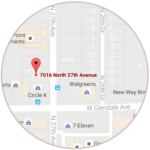
Our clinic is at 7016 N 27th Ave in Phoenix. The hands-on repair phase — hyperbaric oxygen and full-body red light — is for patients who can come to us, most within about 30 minutes of our doors.
The functional-medicine side is different: the root-cause evaluation, the advanced testing, and your treatment plan can be done by telehealth anywhere in the country. If you’re local, you get both. If you’re not, we can still find what your workup missed.
Phoenix · Peoria · Glendale · Sun City · Sun City West · Surprise · Avondale · Goodyear · Scottsdale · Paradise Valley · Tempe
Questions People Ask Us
We test past the standard panel. Most “idiopathic” neuropathy I see has a cause routine labs don’t capture — insulin resistance behind a normal A1c, functional nutrient deficiencies, low-grade inflammation, or a gut driver. In practice, idiopathic usually means under-investigated, not uncaused.
Because controlling blood sugar stops further damage, but it doesn’t repair the nerve that’s already hurt. That repair is its own job — and it’s exactly what the hyperbaric oxygen and red light phase is built for, once the metabolic side is stable.
Peripheral nerves can repair under the right conditions — the limiting factors are usually oxygen, circulation, and cellular energy. Correcting the driver and then supplying those conditions is how we support real recovery. It isn’t instant and it isn’t guaranteed, but it’s a fundamentally different goal than masking pain.
No — and never on your own. Many patients are able to reduce or come off these over time as symptoms improve, but always in coordination with the prescribing physician. We don’t make medication changes for you; we work alongside your other care.
For hyperbaric oxygen and red light, yes — those are hands-on. But the functional-medicine evaluation and testing can be done by telehealth from anywhere in the country, so distant patients can still get the root-cause work that’s the foundation of all of this.
Not necessarily. Long-standing neuropathy may improve partially rather than fully, but “I’ve had it for years” is not the same as “nothing can change.” We’ll give you an honest read on what’s realistic for your situation before you commit to anything.
Let’s Find What Your Workup Missed
If you’ve been told your neuropathy is idiopathic, age-related, or something to just live with, start with a functional-medicine evaluation. We’ll look for the cause the standard workup skipped — and build a plan to both stop the damage and help your nerves heal.
Start Your Functional Medicine Evaluation
Call (602) 864-0304
Curious about the hyperbaric oxygen and red light side? View our HBOT & therapy options.
 In Office
 By Phone

 Google 5.0


