
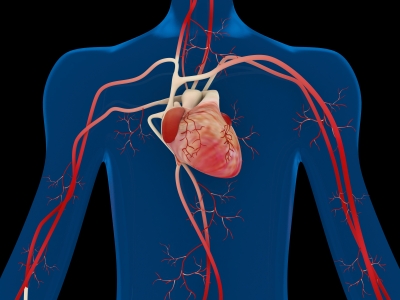
Research is convincing that the following cardiovascular diseases – High Blood Pressure, High Cholesterol, Heart Attacks, Stroke, Cardiac Arrhythmias, Carotid Artery Stenosis and Generalized Atherosclerosis – can all be caused by relatively low levels of Mercury, Cadmium and Lead exposure. This is HUGE, HUGE, HUGE, HUGE.
That’s right 4 “HUGES”! It means these very deadly diseases can be cured. Over and over in my research I found much consensus from experts that people with any of these cardiovascular diseases should be tested for mercury, cadmium and lead.
If you have high blood pressure, ask yourself: Have you been tested for these toxins, or did your clinician prescribe a drug you must take indefinitely?
The medical establishment often dismisses certain diagnostic tests or alternative treatments for lacking sufficient research, even though it frequently uses tests and treatments that have little supporting evidence. Studies have shown that as little as 11 to 14% of medical doctors’ recommendations are based on good evidence, and as much as half of their recommendation are based on opinion alone. Read all about it here at JAMA.

In this case, however, there is plenty of good evidence. The connection between lead, mercury and cadmium to high blood pressure, high cholesterol, heart attacks, stroke, cardiac arrhythmias, carotid artery stenosis and atherosclerosis is beyond any doubt. Much of what I am writing here can be found on the Centers for Disease Control and Prevention’s website. Did you get that? This information does not come from a fringe health blog; the most respected peer-reviewed medical journals publish this research. The more I investigate, the more surprised I am that routine testing for these toxins is not standard practice.
Even more convincing is that we know exactly how these toxins cause the cardiovascular disease. It is not often that we get not only clear evidence of the cause of a problem, but also the understanding of how and why it happens. If you read the references I have at the bottom of this article you can read for yourself how mercury, lead and cadmium cause high blood pressure, high cholesterol, heart attacks, stroke, cardiac arrhythmias, carotid artery stenosis and atherosclerosis. Granted, this is some very technical biochemistry and physiology, but I want you to be convinced because it’s TRUE!
Diagnosing and treating mercury, lead and cadmium toxicity is scientific, safe and effective!
It may take decades to accumulate the levels of these toxins that cause cardiovascular disease, but I have personally witnessed dangerous levels of these toxins being reduced to very low levels in as little as 3 months. There are many variables that affect just how long it takes eliminate these toxins, but getting rid of them is 100% doable!
I can hear you thinking, “Where do we get these toxins?” Great question!

Mercury commonly comes from dental amalgams, fish, and vaccines. The Environmental Protection Agency has determined that a safe daily intake of mercury is less than 0.1 µg/kg/day. For example, if you weigh 68 kg (150 lbs.), the EPA considers 6.8 µg of mercury per day a “safe” intake. One dental amalgam filling releases an estimated 3 to 17 µg of mercury vapor per day. Large predatory fish that eat other fish contain the highest mercury concentrations; for example, swordfish has about 1 µg of mercury per ounce. Nine vaccines that contain thimerosal (50% mercury) as a preservative would result in an estimated exposure of 62 µg of organic mercury.
How are We Exposed to Mercury, Lead, and Cadmium?
Some patients have told me they played with mercury in school. Now, we even use mercury in certain light bulbs—CFLs contain between 100 and 5,000 µg of mercury.
Lead is all around us. Many of us grew up pumping leaded gasoline into our cars. Lead can be in paint, plumbing, batteries, toys, electronic equipment, ceramic products, caulking, military equipment, ammunition and motor oil. Lead is in our soil and therefore can be in our food and water. Lead, as well as all the other heavy metal toxins, transfers from mom to baby, so if mom has these toxins the baby will also be born with them. The real problem here is that once we are exposed to these toxins our bodies tend to hold on to them and accumulate them over our entire lives.
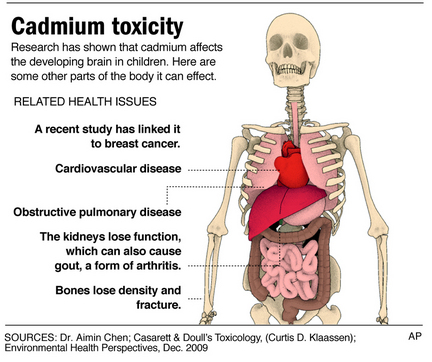
Cadmium is in tobacco smoke, silver solder, phosphate fertilizers and our soil. Additionally, cadmium can be in the air and food. The World Health Organization has established a tolerable weekly intake for cadmium at 7 µg/kg of body weight. So that’s about of 70 µg of cadmium for the average 70-kg (154 lb.) man and 60 µg of cadmium per day for the average 60-kg (132 lb.) woman. It is generally accepted that the average person gets 10 to 25µg of cadmium a day from food. One cigarette has 1 to 2 µg of cadmium. Fossil fuel power generation plants, and the iron and steel industry are places where cadmium may be present. Cadmium levels are higher in the air and soil in areas that have industries that use cadmium.
Exposure to these toxins does not equal absorption. A person whose body contains ample minerals and nutrients absorbs less than a person with marginal nutritional status.
What Should You Do?
The real takeaway is that everyone should test for mercury, lead, and cadmium—especially those diagnosed with high blood pressure, high cholesterol, heart attacks, stroke, cardiac arrhythmias, carotid artery stenosis, or atherosclerosis. Standard drugs that clinicians prescribe for these cardiovascular diseases cause a range of additional problems. Clinicians frequently prescribe statins to lower cholesterol. The U.S. Food and Drug Administration now requires a warning label on statins because they can cause diabetes.
Here’s a TRUE Story of How I Treated One of My Patients
Often folks reluctantly go on these drugs because the alternative of death is worse than the drug. What if the whole time the problem was a mercury, lead or cadmium toxicity problem that could be cured? That was the situation with one of my patients. I have been treating him for his back problem but one day we got talking about all the drugs he was on.
My patient was 62 years old, 6’2″ tall and 260 lbs.
He was on the following drugs for high blood pressure:
- Atenolol
- Felodipine
- Hydrochlorothiazide
- Lisinopril
- Spironolactone
- Hytrin
Even with 6 blood pressure drugs his bp was 156/90.
My patient had these health problems:
- Overweight
- High Blood Pressure
- Frequent Swollen Ankles
- Frequent Stuffy Nose
- Hay Fever
- Canker Sores
- Craves Sugars / Starches
- Troubled by Urgent Urination
- Prostate Disorder
Research-Backed Testing
I did a complete lab work up. We did blood, tissue and a urinary toxic element challenge testing. For the sake of this article I want to show you the part of the testing that is focused on the toxins I’ve been telling you about. Here are the results of the first tests:
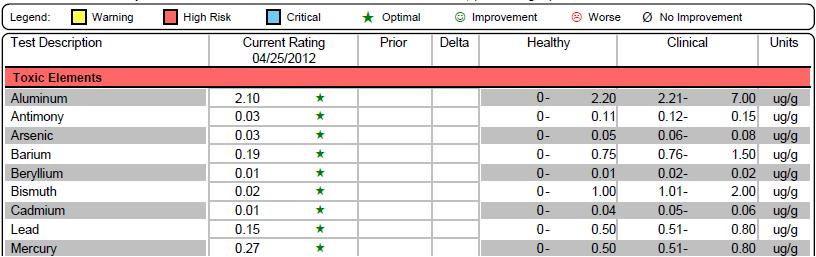
Please notice that according to the tissue mineral analysis my patient is doing great. The majority of times this test is initially done this is what shows up. However look at what the urinary toxic element challenge (UTEA):
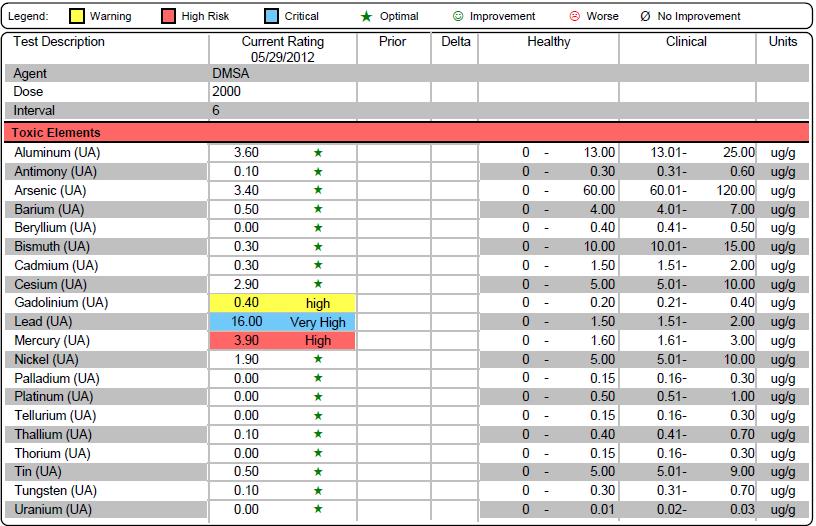
Blue = clinically very high or clinically very low Red = clinically high or clinically low Yellow = a little high or a little low; this can be considered a warning sign that the value is not optimal
The UTEA is a 6 hour urine collection test that uses a chelator called DMSA. The DMSA draws out toxic elements according to molecular weight and body load.
Lead and mercury are the heaviest so they will typically be expelled first. These test results clearly show that the patient is not able to efficiently excrete toxic elements on his own, but we can use the chelator DMSA to slowly and safely help his body remove those stored toxic elements.
What these two tests show is that this patient is storing toxins instead of getting rid of them. Often in re-testing the tissue we will see the toxins. When the toxins start to show up in the re-test it is a good thing. It means that the body is actively working to get rid of the toxins.
Treatment and ReTesting!
Treatment for these toxins uses the DMSA with nutrients. The DMSA “pulls” the toxins out of the tissue in which they are stored. The nutrients “push” the toxins out and replace them. Check out the levels after a round of treatment:

Even though the lead levels are high the patients body began to respond very well. His blood pressure, weight, and other issues have improved.
- Lost 30 lbs
- BP is 132/76
- Completely off Atenolol, Hytrin, Felodipine and Metformin
- Almost off Hydrochlorothiazide and Lisinopril
- Canker sores gone
- Does not crave sugar
- Stuffy nose gone
- Hay fever not nearly as bad
- Urination back to normal

Therapy with this patient is continuing and the lead levels will continue to come down. The patient has kept his medical doctors in the loop about what he is doing with me. The doctors told him they didn’t believe in what he was doing and did not expect anything to happen. When the patient’s blood pressure began to drop he contacted his doctors and they refused to reduce the dosages of his medications. After the patient began to experience fainting spells because of his low blood pressure the doctors finally began to cut back the medication. Needless to say this patient is very happy with the treatment, and as the toxins are completely removed, I expect that the blood pressure medication will not be needed at all.
Start Getting Help Today!
This case is a great example of what the studies on this subject have found. If you have been diagnosed with high blood pressure, high cholesterol, heart attacks, stroke, cardiac arrhythmias, carotid artery stenosis and atherosclerosis, and want to see if lead, mercury or cadmium is the cause of your cardiovascular disease, contact me! I can help you anywhere in the the USA.
References:
- Kopp SJ, Barron JT, Tow JP. Cardiovascular actions of lead and relationship to hypertension: a review. Environ Health Perspective 1988 Jun;78:91
- Tellez-Plaza M, Navas-Acien A, Crainiceanu CM, Guallar E. Cadmium exposure and hypertension in the 1999-2004 National Health and Nutrition Examination Survey (NHANES).
- Houston MC. The role of mercury and cadmium heavy metals in vascular disease, hypertension, coronary heart disease, and myocardial infarction. Altern Ther Health Med. 2007 Mar-Apr;13(2):S128-33


 Google 5.0


