
The Scan Was Clear. The Symptoms Weren’t.
Whether it’s your teenager — cleared at the ER, sent home to “rest,” and still struggling with headaches and brain fog weeks later — or it’s you, months past a concussion and still not feeling like yourself, you already know something the imaging didn’t show: this isn’t better yet.
There may be more healing left to support. Hyperbaric oxygen therapy is a non-invasive way to give an injured brain what it actually needs to finish recovering.
A Normal Scan Tells You What Didn’t Happen — Not What Did
If you’ve been told your CT or MRI is “clean,” that is genuinely good news — it means no fracture and no bleeding. But standard imaging was never designed to see a concussion. A concussion is a metabolic and inflammatory injury at the cellular level: brain tissue gets shaken, local blood flow and oxygen delivery drop, inflammation rises, and the energy machinery of injured neurons struggles to keep up.
That mismatch — real injury, invisible scan — is exactly what produces the headaches, the fog, the fatigue, and the sense of “not feeling like myself” that rest alone doesn’t always resolve. If those symptoms have outlasted the point where you were told they’d be gone, you are not imagining it, and you are not out of options.
How Hyperbaric Oxygen Helps a Healing Brain
Think of it simply: the injured brain is starved for fuel, and hyperbaric oxygen delivers it.
Inside the chamber, the body breathes oxygen under gentle pressure. That pressure dissolves far more oxygen into the blood than breathing room air ever could — and drives it deep into tissue that struggling circulation can’t reach. It floods oxygen-starved areas with exactly what they need to repair.
With that oxygen on board, the goal is to calm the lingering neuroinflammation that drives symptoms, support the growth of new blood vessels, and give the brain’s natural recovery and remodeling the resources it’s been missing. Drug-free, and aimed at the level where the injury actually lives.
“In my experience, nearly everyone who comes in with headaches after a head injury finds real relief. It isn’t always immediate — but the patients who stick with it start to get back what they’d lost.”
The headaches tend to ease first. Then, with time and persistence, the deeper things come back — their emotions, their sense of humor, their ability to think clearly. I’ve watched families tell me they have their person back. For the brain, it is remarkable to witness.
That’s why I’m honest with every patient up front: this rewards persistence. The people who give it a fair, full course are the ones who see how far it can take them.
When the Catch Didn’t Come
A real patient story from our Phoenix clinic. Name changed to protect privacy.
“Mia,” a 16-year-old competitive cheerleader, was the flyer — the athlete tossed into the air and caught at the top of a stunt. She’d done it hundreds of times. This time the catch didn’t come together. She came down outside her teammates’ arms and struck her head on the floor.
At the emergency room, X-ray and CT imaging ruled out the most dangerous outcomes — no skull fracture, no bleeding. Everything came back clear. She was diagnosed with a concussion and sent home with the standard guidance to rest and let it heal.
That’s where many concussion stories are supposed to end. Mia’s didn’t. In the days that followed she had persistent headaches that didn’t ease with rest, a frustrating mental fog, trouble keeping up with schoolwork that had never given her trouble before, and a general sense of not feeling like herself. Her mother, already a patient at our center, knew we had another tool to offer.
The headaches that had dogged her began to lift, and the fog that made school and conversation feel like wading through mud started to clear. By the end of her course, Mia was back to normal and feeling great. Her family’s relief said it all.
This describes the experience of one patient. Individual results vary, and hyperbaric oxygen therapy for concussion and post-concussion symptoms is a supportive, off-label use. Any return to sport should follow standard return-to-play guidance from the treating physician.
What the Research Honestly Shows
You may have read that hyperbaric oxygen “isn’t recommended” for concussion. It’s a fair point to raise — and the honest answer is that the evidence is genuinely mixed. We’d rather tell you that plainly than oversell.
A randomized, prospective trial found hyperbaric oxygen improved brain function and quality of life in mild-TBI patients with lingering symptoms — even years out from the original injury.
Efrati et al., PLOS One, 2013
A randomized controlled trial reported improved cognitive and behavioral function in children with persistent post-concussion symptoms following a course of hyperbaric oxygen.
Nature Scientific Reports, 2022
A retrospective cohort of adults who’d carried post-concussion symptoms since a childhood brain injury found meaningful improvement after hyperbaric oxygen — long after conventional recovery had plateaued.
Frontiers in Neurology, 2026
Several large military trials found no benefit over a sham chamber, and that’s why some bodies don’t recommend it. Researchers continue to debate why — differences in pressure, in how soon after injury patients were treated, and in whether the “sham” was truly inert. The picture isn’t settled. What we can say is that the therapy is well-tolerated, and that we frame it as a supportive, adjunct option — not a guaranteed cure, and not a replacement for the rest of your care.
Questions People Ask Us
No. A normal scan rules out a fracture or bleed — it can’t see a concussion. Concussions are a cellular and metabolic injury that standard imaging isn’t built to detect. A clean scan and real, lingering symptoms can absolutely coexist, and that’s one of the most common situations we see.
Not in our experience. Some of the strongest published results come from patients treated long after their injury — even years out. When symptoms have lingered past the point where rest should have resolved them, that’s usually a sign there’s still healing left to support, not a closed door.
It depends on the person and how long they’ve had symptoms — some need only a short course, others benefit from more. We’ll talk through what makes sense for your situation at the consult. What I tell everyone is the same thing: this rewards persistence. The patients who give it a fair, full course are the ones who see how far it can go.
Headaches often ease earliest. The deeper returns — clear thinking, mood, feeling like yourself again — tend to come with time and a sustained course rather than overnight. Everyone’s timeline is a little different.
Because the evidence is mixed — not negative, mixed — and we treat it as a supportive, well-tolerated option rather than a miracle. If you’ve been doing everything right and still aren’t better, a therapy with real upside and minimal downside is worth an honest conversation. We’ll tell you plainly whether we think it’s a fit for you.
Hyperbaric oxygen is generally very well-tolerated — the most common effects are mild, like ear pressure as you adjust. We’ll review your history at the consult to make sure it’s appropriate for you. No referral is required, and we offer same-week scheduling.
Serving the Greater Phoenix Area
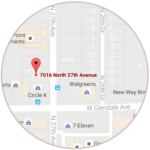
Our clinic is at 7016 N 27th Ave in Phoenix, with a medical-grade hard-shell chamber. We see concussion and TBI patients from across the Valley — most within about 30 minutes of our doors.
Phoenix · Peoria · Glendale · Sun City · Sun City West · Surprise · Avondale · Goodyear · Scottsdale · Paradise Valley · Tempe
Let’s Talk About What’s Still Going On
If a clean scan and lingering symptoms describe you or your child, sit down with Dr. Kilcup for 20 minutes — no chamber time, no pressure, no charge. We’ll review your situation and tell you honestly whether hyperbaric oxygen makes sense for you.
Book a Free 20-Minute Consult
Call (602) 864-0304
Want to see session and package options first? View our HBOT pricing and packages.
 In Office
 By Phone
 Google 5.0


