
Here is a scenario I see in my clinic constantly, and it makes my blood boil.
You go to your doctor. They run a standard cholesterol panel. They look at your LDL (the so-called “bad” cholesterol), see that it’s within the “normal” range—maybe because you’re already on a statin—and they tell you, “Great news! Your lipids are fine. You’re safe.”
They are wrong.
If your doctor is only looking at LDL, they are looking at a single tree and missing the forest fire raging around it.
Here is the truth: You can have perfect LDL levels and still be a walking time bomb for a stroke. Why? Because of a deadly combination that standard care often ignores until it’s too late: Low HDL and High Triglycerides.
This specific imbalance is a hallmark of metabolic dysfunction. It turns your blood into sludge, damages your vessel walls, and screams that your body is inflamed. If you want to truly protect your brain, you need to look beyond the basic numbers. Understanding these stroke root causes is essential for prevention and recovery.
Key Takeaways
- LDL isn’t the only villain: Focusing solely on LDL cholesterol misses the bigger picture of stroke risk.
- The Deadly Ratio: The ratio of Triglycerides to HDL is a far better predictor of heart attack and stroke risk than LDL alone.
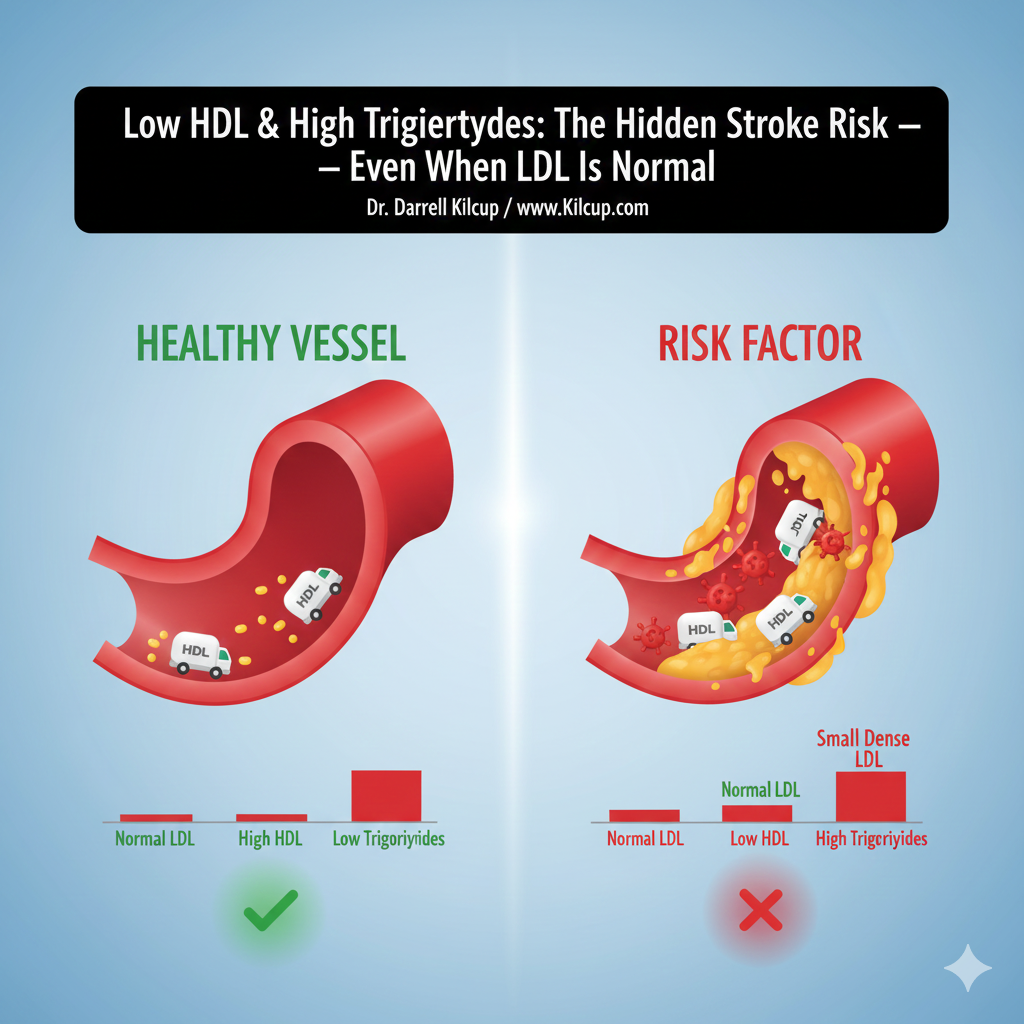
- It’s about “Sludge”: High triglycerides make your blood thick and viscous, while low HDL means you lack the “garbage trucks” to clean it up.
- Sugar, not Fat: High triglycerides are usually caused by excess sugar and carbohydrates, not dietary fat.
- Standard Meds Miss This: Statins lower LDL, but they are often terrible at fixing the low HDL/high triglyceride imbalance.
- You Can Fix It: This is a metabolic problem, which means it has a metabolic solution involving diet, lifestyle, and targeted supplementation.
Estimated reading time: 9 minutes
The Core Problem: Why This “Silent” Imbalance Causes Strokes
Let’s get technical for a second, but I promise to keep it simple.
Most people think of cholesterol as a pipe-clogging grease. But it’s more complex than that. To understand why Low HDL and High Triglycerides are so dangerous, you need to understand what they actually do.
1. The Broken Garbage Truck (Low HDL)
Think of HDL (High-Density Lipoprotein) as the garbage trucks of your bloodstream. Their job is to cruise through your arteries, scoop up excess cholesterol and plaque, and haul it back to the liver to be disposed of.
When your HDL is low (usually under 40 mg/dL for men, 50 mg/dL for women), it’s like the sanitation department went on strike. The garbage (plaque) stays in the streets (your arteries).
2. The Traffic Jam (High Triglycerides)
Triglycerides are a type of fat found in your blood. They are your body’s storage form of energy. When you eat more calories—specifically sugar and processed carbs—than you burn, your body turns them into triglycerides.
When your triglycerides are high (over 150 mg/dL, though functionally I want them under 100), your blood becomes viscous. It’s thick. It’s sludgy.
3. The Perfect Storm
Now, put them together. You have thick, sludgy blood full of fat (High Triglycerides) and no garbage trucks to clean it up (Low HDL).
This leads to two major problems:
- Small Dense LDL: High triglycerides actually change the shape of your LDL particles. Instead of being big and fluffy (like a beach ball), they become small and hard (like BB pellets). These small particles can easily burrow into the artery wall and cause a stroke. Standard tests do not measure particle size.
- Clotting Risk: High triglycerides increase the levels of clotting factors in your blood. A stroke is, essentially, a clot or a bleed. Thick blood clots faster.
According to the American Heart Association, managing these lipid levels is critical for vascular health, yet millions of patients walk around with this specific imbalance untreated because their LDL looks “fine.”
The “Golden” Ratio
I don’t look at these numbers in isolation. I look at the Triglyceride-to-HDL Ratio.
- Take your Triglyceride number.
- Divide it by your HDL number.
If the result is above 2, you have a problem. If it is above 3, you are in the danger zone for insulin resistance and stroke risk.
Real Patient Story: Doug’s “Normal” Labs Were a Lie
Let me tell you about Doug. When Doug came to me, he was in a bad spot. He had suffered a stroke that left him unable to work, unable to drive, and stripped of his emotional regulation. He was a “flatliner“—no joy, no sadness, just existence.
Here’s the kicker: His cardiologist was relatively happy with his numbers because his LDL was suppressed by medication.
But when I ran his blood work, I saw a disaster.
- His Triglycerides were through the roof (over 250 mg/dL).
- His HDL was rock bottom (hovering around 30 mg/dL).
- His ratio was nearly 8:1.
His blood was essentially syrup. No wonder he had a stroke! His brain wasn’t getting the oxygen and flow it needed because his vascular system was gummed up. Standard care completely missed this because they were high-fiving over his LDL.
We didn’t just give him another pill. We put him on a strict functional protocol. We cut the inflammatory carbs that were driving his triglycerides up. We used high-dose fish oil and specific nutrient support to boost his HDL. We used Hyperbaric Oxygen Therapy to force oxygen through that sludge and into his starving brain cells.
The result? Doug didn’t just survive; he came back to life. He’s driving again. He’s working again. He can feel happiness again. And his Triglyceride/HDL ratio? It’s now a perfect 1.5.
How Functional Medicine Actually Fixes This
If you have Low HDL and High Triglycerides, a statin is rarely the answer. This is almost always a lifestyle and metabolic issue. Here is how we attack it.
Comprehensive Testing (What Standard Labs Miss)
You cannot fix what you do not measure. A basic lipid panel is 1970s medicine. You need:
- NMR Lipoprofile: This measures the size of your cholesterol particles. It tells us if you have those dangerous “BB pellet” LDLs caused by high triglycerides.
- Fasting Insulin & HbA1c: High triglycerides are almost always a sign of insulin resistance (pre-diabetes). If we don’t fix your blood sugar, we can’t fix your stroke risk.
- Inflammatory Markers (hs-CRP, Homocysteine): These tell us if the cholesterol is actively damaging your arteries.
Targeted Interventions
1. Nutrition: Flip the Pyramid
The government food pyramid (high carb, low fat) is what caused this epidemic. To lower triglycerides and raise HDL, you must do the opposite.
- Eliminate the “White” Poisons: Sugar, flour, pasta, bread. These spike insulin, which immediately tells the liver to pump out triglycerides.
- Eat Healthy Fats: Olive oil, avocados, nuts, and fatty fish. Paradoxically, eating good fat helps clear bad fat from the blood and raises HDL.
- Intermittent Fasting: This is a powerful tool to lower insulin and force your body to burn triglycerides for fuel.
2. Supplements That Work
- Omega-3 Fatty Acids (High Quality): Prescription-grade fish oil is one of the most effective tools for lowering triglycerides.
- Niacin (Vitamin B3): One of the few things that actually raises HDL effectively. Note: Do not do this without supervision, as it can cause flushing and liver issues if dosed incorrectly.
- Berberine: Helps fix the blood sugar issues driving the triglyceride production.
Integrative Therapies That Accelerate Recovery
If you have this lipid imbalance, your circulation is compromised. We need to bypass the traffic jam.
- Hyperbaric Oxygen Therapy (HBOT): By pressurizing the environment, we dissolve oxygen directly into the plasma of your blood. It doesn’t matter if your blood is “sludgy” or if your hemoglobin is busy; HBOT forces life-giving oxygen into the brain tissue that has been starved by stroke. It reduces inflammation and stimulates the growth of new blood vessels (angiogenesis).
- Red Light Therapy: This stimulates the mitochondria (power plants) in your cells. It helps reduce the systemic inflammation caused by those high triglycerides and supports the healing of the vessel walls.
What You Can Do Right Now
Look, I know this is a lot of science. But your life depends on taking action. Here is your checklist:
- Calculate Your Ratio: Go find your last blood test. Divide Triglycerides by HDL. If it’s over 2, you need to make changes today.
- Ditch the Sugary Drinks: Soda, juice, and sweetened coffee are “triglyceride bombs.” Switch to water, black coffee, or tea.
- Move Your Body: Exercise burns triglycerides for fuel. A 30-minute walk after dinner can significantly lower your numbers. CDC guidelines emphasize physical activity as a primary prevention strategy.
- Eat Fatty Fish: Salmon, mackerel, or sardines 3 times a week. If you can’t do that, get a high-quality Omega-3 supplement (look for high EPA/DHA).
- Get the Right Test: Ask your doctor for an NMR Lipoprofile or “Particle Size” test. If they won’t run it, find a functional medicine doctor who will.
- Don’t Fear the Avocado: Stop eating low-fat “diet” foods. They are usually replaced with sugar/carbs that raise triglycerides. Eat real, whole fats.
FAQ Section
Q: My doctor says my cholesterol is genetic. Can diet really change it? A: While there is a genetic component (like Familial Hypercholesterolemia), Low HDL and High Triglycerides are overwhelmingly lifestyle-driven. I have seen hundreds of patients reverse this “genetic” destiny simply by changing what they eat and how they move.
Q: Is having high triglycerides really that bad if I feel fine? A: Yes. High triglycerides are silent killers. You won’t “feel” your blood thickening until a clot forms. Research from the National Institutes of Health (NIH) consistently links elevated triglycerides with increased risk of ischemic stroke.
Q: Can I just take a pill to raise my HDL? A: There isn’t a great drug for raising HDL. Pharmaceutical trials for HDL-raising drugs have largely failed. The best way to raise HDL is exercise, healthy fats, and niacin—nature’s tools, not big pharma’s.
Q: Does alcohol affect triglycerides? A: Huge yes. Alcohol is processed by the liver very similarly to sugar. Heavy drinking is a massive driver of high triglycerides. If your numbers are high, you need to pause the alcohol.
Q: How fast can I fix this? A: That’s the good news. Unlike other markers, triglycerides change fast. You can drop your triglycerides significantly in just 3 to 4 weeks with strict dietary adherence.
Conclusion
Let me be blunt: If you have had a stroke, or are trying to prevent one, looking at LDL alone is like checking the tire pressure on a car with no engine. It’s not enough.
Low HDL and High Triglycerides create a toxic, inflammatory, stroke-prone environment in your blood. Standard medicine often ignores this ratio, but in Functional Medicine, we view it as a primary target.
You have the power to change these numbers. You can thin your blood, clear the plaque, and heal your brain—but you have to treat the root cause, not just the symptom.
If you are ready to stop guessing and start healing, explore our functional medicine stroke recovery program to address your unique root causes.

 Google 5.0


