
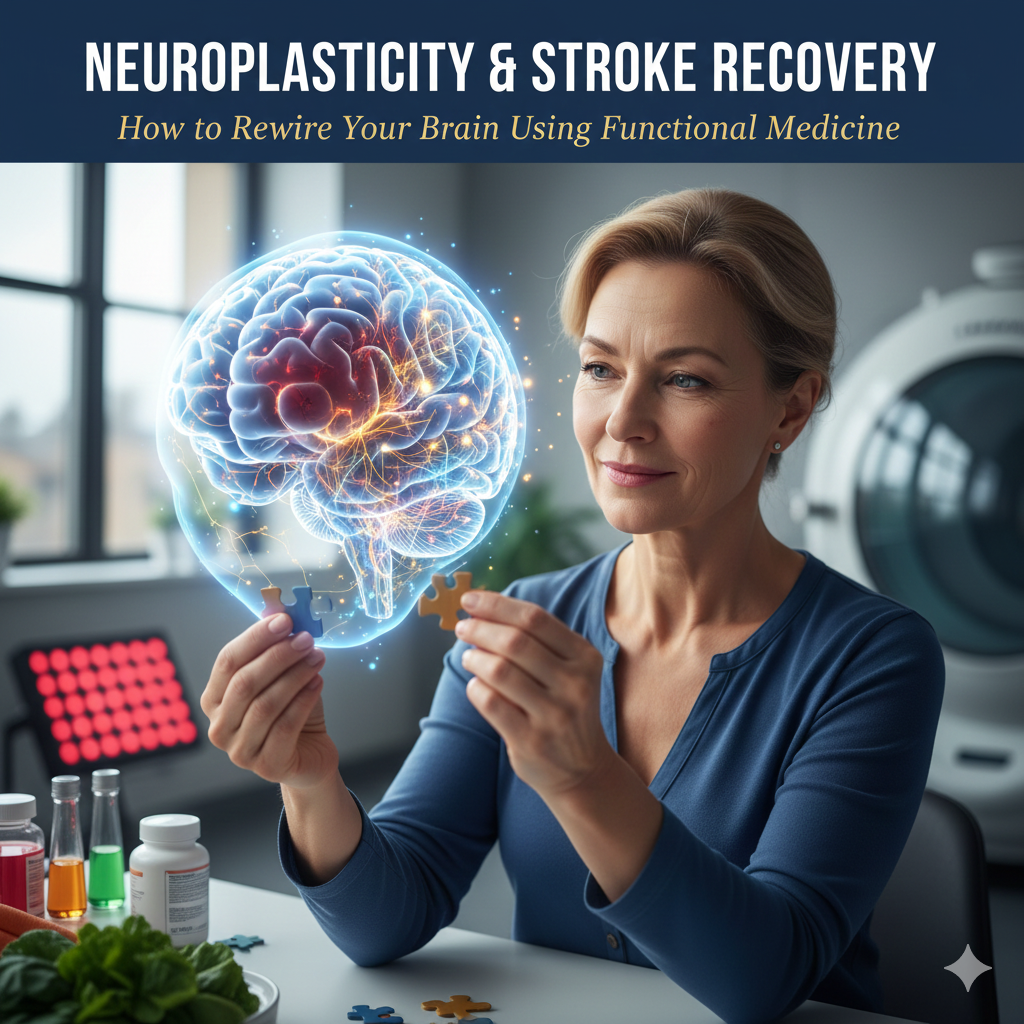
Stop Waiting for Your Brain to “Just Heal”
Let me be blunt: The “wait and see” approach to stroke recovery is lazy medicine.
If you’ve had a stroke, you’ve likely been told that the first six months are your “window” for recovery and that after that, you’re basically stuck with whatever function you’ve regained. That is a lie. It is an outdated view of the human brain that ignores one of the most powerful forces in biology: Neuroplasticity.
Your brain is not a static piece of hardware. It is more like a dynamic, living map. When a stroke happens, a part of that map is wiped out. But here is the truth nobody tells you: Your brain has the literal, physical ability to build “detour” pathways around the damaged areas.
However, your brain won’t just do this on its own if it’s drowning in inflammation or starved of the right nutrients. You can do all the physical therapy in the world, but if your internal “chemistry” is a mess, those new neural connections won’t stick.
My goal isn’t to just manage your symptoms. My goal is to find the root causes—the fires in your gut, the toxins in your blood—that are preventing your brain from rewiring itself. Understanding these [preventing a second stroke] strategies is the first step toward creating an environment where healing is actually possible.
🔑 Key Takeaways: Rewiring Your Brain
- Neuroplasticity is Lifetime: Your brain can create new connections at 80 just as it can at 20, provided it has the right fuel.
- The “Construction” Cost: Building new neural pathways requires massive amounts of cellular energy (ATP). If your mitochondria are failing, your recovery will stall.
- Inflammation is a Signal Jammer: Chronic inflammation acts like static on a radio; it prevents neurons from communicating and forming new bonds.
- Testing is Not Optional: We must look at markers like BDNF and systemic inflammation to see why your “rewiring” has plateaued.
- Virtual Support Works: I work with patients across the country to run the right tests and build a roadmap, even if they aren’t local for my in-office therapies.
Estimated reading time: 8 minutes
How the Brain Actually Heals: The Science of the “Detour”
Here is what happens inside your head after a stroke. Think of your brain like a busy highway system. A stroke is a massive bridge collapse. Standard care tries to clear the rubble, but functional medicine focuses on building the side roads.
The Goal: Synaptogenesis and Pruning
For you to get your speech back, or to move your arm again, your brain has to perform synaptogenesis—the creation of new synapses between neurons. It literally has to “reach out” and find a new neighbor to talk to.
But stay with me here, because this is the part your doctor isn’t mentioning: This process is biologically expensive. It requires high levels of a protein called BDNF (Brain-Derived Neurotrophic Factor), which I call “Miracle-Gro for the brain.” If your body is too busy fighting gut infections or dealing with high blood sugar, it won’t produce enough BDNF to build those new roads.
The Obstacle: The “Toxic Fog” of Inflammation
I see this every week: patients who are doing their exercises but aren’t getting better. Why? Because they are in a state of Neuroinflammation. When the brain is inflamed, the “cleanup crew” cells (microglia) go into attack mode. Instead of helping build new connections, they accidentally tear down the ones you’re trying to make. We have to clear the “fog” before the brain can see where to build the next road.
Research shows that systemic inflammation—often starting in the gut—directly hinders this plastic recovery (NIH/PubMed research).
Real Patient Story: Doug’s Mental “Reboot”
Let me tell you about Doug again. When Doug came to see me after his stroke, he felt like a stranger in his own head. He had “flat affect”—he couldn’t feel or show emotion—and his memory was shot. Standard neurology told him he’d reached his “maximum medical improvement.”
Standard care completely missed this.
When we ran his labs, we didn’t just look at his brain; we looked at his biology. We found:
- High Homocysteine: This was “thinning” his neural protection.
- Massive Gut Dysbiosis: His gut was sending inflammatory signals straight to his brain via the vagus nerve.
- Low Vitamin D and Omega-3s: He didn’t have the raw building blocks to repair the myelin (the insulation) on his nerves.
Our general treatment approach wasn’t to give him a “brain pill.” It was to fix his gut and lower his systemic fire. Once we cleared the “toxic fog,” Doug’s brain finally had the resources to start neuroplasticity. Within months, his emotions returned, his brain fog lifted, and he started driving again. His brain didn’t just “fix itself”—we gave it the tools to do the work.
How Functional Medicine Actually Fixes This
We don’t guess. We test. Whether you are in my office or we are working together virtually, we use a professional roadmap to identify why your brain is stuck.
Comprehensive Testing (What Standard Labs Miss)
- BDNF Assessment: We look at your potential for growth.
- Advanced Inflammatory Markers: We check hs-CRP and Lp-PLA2 to see if your blood vessels are still “on fire.”
- Nutritional Micronutrient Testing: We check for the specific B-vitamins and minerals that act as the “cement” for new neural connections.
- Stool Testing: We look for the “bad actors” in your gut that produce neurotoxins.
General Treatment Approaches
Our goal is to create a “Pro-Growth” environment.
- Lowering the Load: We identify and remove inflammatory foods and environmental toxins that are “jamming” your neural signals.
- Optimizing Fuel: We focus on a high-fat, moderate-protein approach to provide the brain with the phospholipids it needs to build new cell membranes.
- Strategic Stimulation: We don’t just recommend “puzzles”; we look at how to stimulate the brain when it is at its most receptive state.
Integrative Therapies That Accelerate Recovery
For my local patients, we use tools to “force” the energy into the brain.
- HBOT (Hyperbaric Oxygen Therapy): This floods the brain with the oxygen required for the “construction project” of neuroplasticity.
- Red Light Therapy: This uses light to stimulate the mitochondria in your neurons to produce more energy. If you are out of state, don’t worry—the most important part of the process is the testing and strategy, which we can handle virtually.
What You Can Do Right Now
Look, I know this is a lot. You shouldn’t try to treat yourself with random supplements—that’s like throwing random bricks at a construction site and hoping a house appears. But you can start preparing the “site” today.
- Stop the “Neural Drains”: Eliminate sugar and seed oils for 30 days. These are direct neuro-inflammatory triggers.
- Prioritize Sleep: Neuroplasticity happens while you sleep. If you aren’t getting 7-8 hours, your “construction crew” is on strike.
- Intermittent Fasting (General Goal): Giving your digestive system a break can help trigger “autophagy”—the brain’s way of cleaning out cellular trash.
- Demand a Full Panel: Don’t settle for basic blood work. Ask for your Homocysteine and hs-CRP levels.
- Hydrate with Electrolytes: Your brain is an electrical organ. It needs minerals to send signals.
- Schedule a Consultation: Stop guessing. Let’s get the right tests and build a professional roadmap.
FAQ Section
Q: Is it too late for me if my stroke was over a year ago? A: Let me be blunt: No. The brain is plastic until the day you die. The reason people stop recovering is usually that their “internal environment” is so toxic or nutrient-depleted that the brain stops trying to heal. When we fix the chemistry, the recovery often restarts.
Q: Can I do this virtually? A: Absolutely. I work with people nationwide. We coordinate the specialized testing near you, and then we meet via video to build your strategy. You don’t need to be in my office to get a world-class functional medicine plan.
Q: Why hasn’t my neurologist mentioned neuroplasticity? A: Neurologists are experts in diagnosis and acute crisis management. They are trained to see what is broken, not necessarily how to optimize the repair process through nutrition and gut health. We aren’t replacing them; we are adding the “repair crew” to the team.
Q: Should I just buy a “Brain Support” supplement online? A: Please, don’t. You can’t supplement your way out of a leaky gut or heavy metal toxicity. You need to know why your brain is struggling before you start adding nutrients. Test, don’t guess.
Conclusion: Take the Lead in Your Recovery
The “window” for stroke recovery only closes if you let it. By identifying the root causes of inflammation and providing the brain with the building blocks it needs, we can unlock the power of neuroplasticity.
Don’t spend another year “waiting” for things to get better. Take a Confident step forward. Whether you are local or across the country, let’s find out what is really holding your brain back.
Explore our functional medicine stroke recovery page to learn how we can address your unique root causes and start your personalized recovery journey.

 Google 5.0


