
Estimated reading time: 16 minutes
Why I Put Nearly Every Stroke Patient in My Hyperbaric Chamber
I’m going to share a perspective that may challenge conventional neurology.: the standard “wait and see” approach to stroke recovery is lazy medicine.
After 35 years of treating stroke patients in my functional medicine clinic, I can tell you with absolute certainty that your brain has an ASTONISHING capacity to repair itself—IF you give it what it needs.
And what it needs is oxygen. Massive amounts of it. Under pressure.
I’m talking about Hyperbaric Oxygen Therapy (HBOT), and it’s sitting right here in my clinic because I’ve watched it transform outcomes that conventional medicine wrote off as “permanent deficits.”
Now, you can find HBOT clinics. They’re out there—usually focused on wound healing or sports injuries. But here’s what you WON’T find: a clinic that integrates HBOT with comprehensive functional medicine testing AND targeted red light therapy specifically for stroke recovery. That’s what makes my approach different. I’m not just putting you in a chamber and hoping for the best. I’m addressing WHY your brain’s vascular system failed in the first place while simultaneously giving it the most powerful repair tools available.
Let me explain what’s actually happening: When you breathe regular air, your red blood cells carry oxygen to your brain. But after a stroke, parts of your brain are STARVING—and those red blood cells can’t deliver enough through damaged vessels. HBOT doesn’t play by those rules. It dissolves oxygen directly into your blood plasma, bypassing the red blood cell limitation entirely and FLOODING your injured brain tissue with 10-15 times more oxygen than normal.
But here’s what gets me excited: that oxygen doesn’t just keep struggling neurons alive. It triggers three critical repair mechanisms that I can actually MEASURE in my patients: it grows NEW blood vessels around damaged areas, it activates stem cells that help rebuild brain tissue, and it supercharges neuroplasticity so your brain can rewire itself.
This isn’t theory from some textbook. This is what I DO. Every single week, I’m putting stroke patients in my hyperbaric chamber and watching them recover function their neurologists said was gone forever.
In this article, I’m going to show you exactly how HBOT works, why I combine it with functional medicine interventions that address underlying causes of stroke, and what real protocols look like in my clinic—including the specific results my patients achieve.
Key Takeaways: What I’ve Learned About HBOT in 35 Years
- I’m one of the only clinics integrating all three modalities: HBOT chambers exist—but finding one that combines hyperbaric oxygen with functional medicine lab work AND red light therapy for stroke? That’s what sets my practice apart
- I use 1.5-2.0 ATA pressure because that’s what the research—and my clinical results—support: Delivers 10-15X more oxygen dissolved directly into plasma
- Pressure + Oxygen = Measurable Brain Repair: I’ve watched HBOT trigger new blood vessel growth, brain rewiring, and stem cell activation on follow-up imaging
- The recovery window is WIDER than neurologists claim: I’ve treated patients 3, 5, even 7 years post-stroke with significant functional improvements
- HBOT works exponentially better when I fix the metabolic problems first: High homocysteine, inflammatory TMAO, and oxidized lipids actively block the repair HBOT is trying to create
- My typical protocol is 40-60 sessions at 90 minutes each: That’s what it takes to trigger sustained angiogenesis and neuroplasticity
- I stack Red Light Therapy with HBOT in my clinic: Red light optimizes mitochondria so cells can USE the massive oxygen boost more efficiently
- This is NOT experimental in my practice—it’s standard care: I have a hyperbaric chamber in my clinic because it works, period
The Core Mechanism of HBOT: What I See Happening at the Cellular Level
Here’s what I tell every stroke patient who walks into my office: your brain uses 20% of your body’s oxygen supply despite being only 2% of your body weight. It’s an oxygen HOARDER.
And when a stroke cuts off blood flow, you don’t just lose neurons in the core area where cells die immediately. You lose function in what we call the “penumbra”—the surrounding zone where cells are ALIVE but struggling.
According to CDC stroke statistics, someone in the United States has a stroke every 40 seconds—and many are left with significant deficits because their brain’s oxygen supply was compromised.
Here’s what standard medicine misses: these struggling cells can survive for WEEKS, MONTHS, even YEARS in this compromised state. They’re like lights flickering during a brownout—not dead, just barely functioning.
I see this on brain imaging all the time. And I see these same areas light up on follow-up scans after HBOT protocols.
Let me break down the three mechanisms I’m targeting every time I put someone in my chamber:
Mechanism 1: Dissolving Oxygen Directly Into Plasma
Under normal conditions, oxygen rides on red blood cells. That’s fine—until the blood vessels supplying part of your brain are damaged or inflamed after a stroke.
Red blood cells are big. They can’t squeeze through compromised vessels. Some brain areas simply don’t get serviced anymore.
When I put you in my hyperbaric chamber at 1.5 to 2.0 atmospheres pressure while you breathe 100% oxygen, the physics changes completely. That oxygen DISSOLVES directly into your blood plasma—not just binding to hemoglobin, but saturating the fluid itself.
Think of red blood cells as delivery trucks. Plasma is the air. HBOT turns your blood into an oxygen-saturated fluid that can seep into tissues through ANY remaining pathway—tiny capillaries, damaged vessels, even direct tissue diffusion.
The result: Brain tissue oxygen levels can increase by 1000-1400% during HBOT sessions.
Research citation: https://pmc.ncbi.nlm.nih.gov/articles/PMC8533945/
That’s not a typo. One thousand percent. That matches what I see clinically: patients who’ve plateaued for months suddenly start making gains.
Mechanism 2: Growing New Blood Vessels (Angiogenesis)
This is where HBOT goes from “life support” to “active reconstruction.”
When I expose your brain tissue to dramatically elevated oxygen levels repeatedly—and repetition is KEY here—it triggers a genetic response. Your body interprets the oxygen-rich environment as a signal to grow NEW blood vessels.
I’ve been using HBOT for stroke recovery for over a decade, and the research from Tel Aviv showing measurable increases in vascular density matches exactly what I see: new capillary networks forming around stroke-damaged tissue on follow-up imaging.
These new vessels create alternate routes for oxygen and nutrients to reach areas that were starving. It’s like building new highways around a collapsed bridge.
And here’s what matters for you: this is PERMANENT. You’re building new infrastructure.
Mechanism 3: Activating Stem Cells and Neuroplasticity
This mechanism is why I get passionate about HBOT.
Your brain WANTS to rewire itself after a stroke. That’s neuroplasticity. But it needs fuel and resources. HBOT provides both.
First, the elevated oxygen creates an optimal metabolic environment for neurons to extend new connections. Second—and this is critical—HBOT mobilizes your body’s own stem cells.
A landmark study from the University of Pennsylvania published in the American Journal of Physiology documented that circulating CD34+ stem cells increased by 800% (eightfold) over a course of 20 HBOT treatments.
Research citation: https://pubmed.ncbi.nlm.nih.gov/16299259/
I don’t just read about this. I WATCH it happen. Patients who couldn’t move their right hand for six months suddenly start getting finger movement back during week 5 of their HBOT protocol.
That’s stem cells migrating to injured tissue and differentiating into new neurons and supporting cells.
HBOT also dramatically reduces inflammation in the injured tissue. Chronic inflammation after a stroke is like trying to heal a wound that keeps getting infected. HBOT downregulates inflammatory cytokines and creates a healing environment instead of a hostile one.
The combination of these three mechanisms is why I see patients recover function their neurologists told them was impossible.
Real Patient Story: Why Frank’s Recovery Changed How I Practice
Let me tell you about Frank, because his case is exactly why I installed a hyperbaric chamber in my clinic.
Frank came to me six months post-stroke. Middle cerebral artery occlusion at age 62. He’d done everything conventional medicine told him to do: got tPA, went through inpatient rehab, followed up with his neurologist.
Six months later, he’d plateaued. He could walk with a cane, had maybe 40% function in his right arm, and described his thinking as “muddy.” His neurologist told him, “This is as good as it gets.”
That’s when he found me.
Here’s what his neurologist completely missed: Frank’s homocysteine was 18 (should be under 7), his TMAO was inflammatory, and his NMR lipid panel showed massive amounts of small, dense LDL particles—the kind that cause vascular inflammation and impair blood flow.
His brain was trying to heal in a metabolic environment that was actively BLOCKING recovery.
I put Frank on my comprehensive functional medicine protocol: we fixed his methylation pathways with targeted B vitamins, shifted his diet to lower TMAO production, addressed his inflammatory lipids, and supported his mitochondria with CoQ10 and other nutrients.
Then we started HBOT: 40 sessions at 1.5 ATA, 90 minutes per session, 5 days per week.
Here’s what I watched happen:
By session 15, Frank’s brain fog lifted. “It’s like someone cleaned a dirty window,” he told me. By session 25, he was making measurable gains in right arm function—movements that hadn’t budged in six months. By session 40, his wife told me something that made my day: “He’s HIMSELF again. That emotional flatness is gone.”
Frank’s cognitive scores improved by 23 points. His right arm function went from 40% to about 75%. He ditched the cane.
The HBOT didn’t do this alone. The functional medicine created the foundation by fixing WHY his vascular system was compromised. But the HBOT provided the concentrated repair stimulus his brain needed to actually REBUILD.
This is what I do. This is why I do it.
Why I Combine HBOT with Functional Medicine in Every Stroke Case
Here’s a hard truth I learned early in my practice: I can put someone in my hyperbaric chamber for 60 sessions, and if their body is metabolically broken, the results will be mediocre.
This is the problem with most HBOT clinics—they treat the chamber like a standalone intervention. They don’t test homocysteine. They don’t measure TMAO. They don’t look at NMR lipid panels or check for methylation defects. They just run the protocol and hope.
That’s not how I practice.
Why? Because HBOT is a delivery system. It’s a fire hose of oxygen and a trigger for repair mechanisms. But if you don’t have the raw materials to BUILD with, if your metabolic environment is still inflammatory and hostile, you’re trying to construct a house during a hurricane.
This is the integrative approach that separates my clinic from standalone HBOT centers: every stroke patient gets comprehensive functional medicine testing BEFORE we start the chamber sessions. I need to know what’s blocking your recovery, fix those obstacles, and THEN deploy HBOT when your body is actually ready to use it.
What I Test and Why It Matters
When you come to my clinic, I’m running labs that your neurologist probably never thought to order:
Homocysteine: I need this under 7. High homocysteine is directly neurotoxic and inflammatory to blood vessels. You can’t grow healthy new vessels in a homocysteine-toxic environment. HBOT is trying to build blood vessels—homocysteine is actively destroying them. I fix this with methylated B vitamins.
TMAO: Elevated TMAO from gut bacterial metabolism damages endothelial cells and blocks vascular repair. I test this because if it’s high, I need to address your gut health and shift your diet BEFORE HBOT will work optimally.
NMR Lipid Panel: Standard cholesterol tests are worthless. I need to see your particle size and count. Small, dense LDL particles burrow into arterial walls and trigger oxidative stress that counteracts HBOT’s anti-inflammatory effects. I address this with targeted nutrition and supplements.
Nutritional status: I’m checking omega-3 index, vitamin D, B12, folate, magnesium—because HBOT triggers repair, but your body needs materials to BUILD with. If you’re deficient in vitamin C, copper, or lysine, angiogenesis gets compromised.
HBOT creates the environment and stimulus. Functional medicine removes the obstacles and provides the tools.
In my clinic, they work together. Always.
Why I Add Red Light Therapy to Most HBOT Protocols
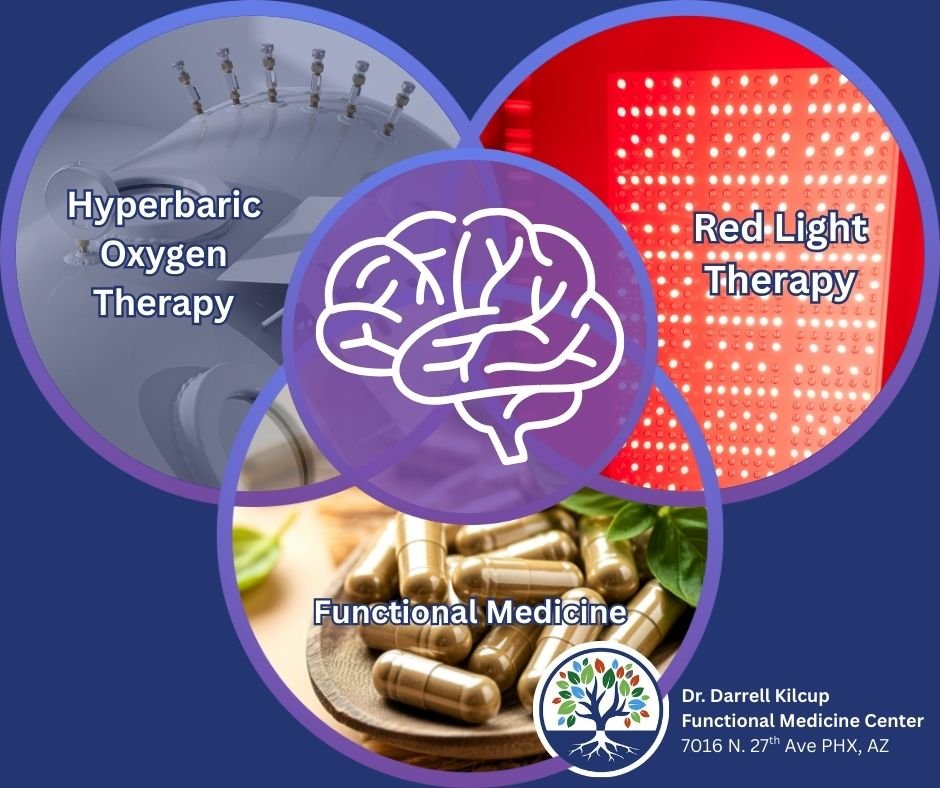
Here’s another key differentiator in my practice: I have both a hyperbaric chamber AND red light therapy panels in my clinic because they’re synergistic.
Most HBOT facilities don’t do this. They focus solely on the chamber. But I’ve learned that stacking these modalities produces outcomes neither therapy achieves alone.
Research supporting HBOT + Red Light combination: https://www.oxycell.com/synergy-of-photobiomodulation-red-light-therapy-and-hyperbaric-oxygen-therapy-hbot/
Here’s the logic: HBOT floods your cells with oxygen. But oxygen is only useful if your mitochondria can USE it to produce ATP.
Red Light Therapy (photobiomodulation) optimizes mitochondrial function by stimulating cytochrome c oxidase—a key enzyme where ATP gets generated. Near-infrared wavelengths (660-850nm) penetrate deep into tissue, reaching brain cells and activating this enzyme while also promoting neurogenesis and reducing neuroinflammation.
Research on photobiomodulation for brain injury: https://pmc.ncbi.nlm.nih.gov/articles/PMC5803455/
The result? Your mitochondria are PRIMED to utilize the oxygen boost from HBOT.
I often stack these therapies: red light session right before HBOT. Patients report faster improvements in energy and cognition when I combine them.
This is the three-pronged approach you won’t find elsewhere: functional medicine to fix the metabolic problems, red light therapy to optimize cellular energy production, and HBOT to deliver massive oxygen and trigger repair mechanisms. Each amplifies the others.
What an HBOT Protocol Looks Like in My Clinic
Let me walk you through exactly what happens when you come to my office for stroke recovery:
Step 1: Comprehensive Functional Medicine Workup
First visit, we’re testing: homocysteine, TMAO, NMR lipids, inflammatory markers, vitamins, minerals, methylation genetics. I need to know what’s blocking your recovery before we start.
This isn’t optional. And it’s what separates my approach from typical HBOT centers that just run chamber protocols without addressing underlying metabolic dysfunction. I don’t start HBOT until I understand your metabolic environment.
Step 2: Addressing Root Causes First
Based on your labs, I’m designing a personalized protocol to:
- Lower homocysteine (methylated B vitamins, betaine)
- Reduce TMAO (gut health interventions, dietary shifts)
- Optimize lipid particles (omega-3s, fiber, targeted nutrients)
- Correct deficiencies systematically
We usually need 2-4 weeks of metabolic optimization before HBOT starts.
Step 3: The HBOT Protocol
My standard stroke recovery protocol:
- 40-60 sessions (I start with 40, extend based on response)
- 90 minutes per session including pressurization/depressurization
- 1.5 to 2.0 ATA pressure (I use 1.5 ATA for most patients, 2.0 for chronic cases)
- 5 sessions per week (Monday-Friday)
- 100% oxygen via mask
You’re lying comfortably in the chamber. Most patients read, listen to music, or nap. Some mild ear pressure initially (like a plane landing), but it equalizes quickly.
Step 4: Tracking Progress
I’m measuring improvements objectively:
- Cognitive testing at baseline, session 20, session 40
- Motor function assessments weekly
- Patient-reported outcomes (sleep, energy, mood)
- Follow-up imaging when appropriate
I want DATA, not just feelings.
Step 5: Stacking Red Light Therapy
For most stroke patients, I add 20-30 minutes of near-infrared red light therapy before each HBOT session. This primes the mitochondria.
Step 6: Ongoing Functional Medicine Support
Throughout the HBOT protocol and after, we’re maintaining nutritional optimization. The metabolic support doesn’t stop when HBOT ends.
What My Patients Ask Me About HBOT
“How much does this cost?”
I’m going to be straight with you: insurance usually doesn’t cover HBOT for stroke recovery, even though the research supports it.
In my clinic, costs vary based on package size, but you’re looking at a meaningful investment. For most patients, it’s $6,000-$12,000 for a complete 40-session protocol.
Yes, that’s real money. But compare that to the cost of long-term disability and reduced quality of life.
I offer payment plans because I want people to access this therapy, not just those who can write a check.
“Is it safe?”
I’ve been using HBOT for years. It’s remarkably safe when done correctly.
Most common side effects are minor: ear pressure (like a plane), temporary vision changes (mild nearsightedness that resolves), occasional fatigue after sessions.
Serious complications are rare: oxygen toxicity (prevented by air breaks), barotrauma (prevented by proper equalization).
I screen carefully for contraindications: untreated pneumothorax, certain medications, severe COPD.
“How soon will I see results?”
This varies, but here’s what I typically see in my clinic:
- Weeks 1-2: Better energy, less fatigue
- Weeks 3-4: Cognitive clarity improves
- Weeks 5-8: Motor function gains, mood improvements
Some patients are rapid responders (improvements by session 10). Others are slow responders (major shifts around session 35).
Don’t panic if you don’t feel dramatic changes immediately. The cellular work is happening even before you consciously notice it.
“Am I too old for this?”
I’ve treated stroke patients in their 80s with excellent results. Age isn’t a limiting factor—overall health is.
The oldest patient I’ve put in my chamber was 83, three years post-stroke. She regained enough hand function to start painting again.
Age is not an excuse to give up.
“What if I’m years past my stroke?”
This is critical: I’ve successfully treated patients 3, 5, even 7 years post-stroke.
The old “recovery window” thinking is outdated. Your brain’s capacity for neuroplasticity doesn’t disappear—it just needs the right stimulus.
Research from Israel showed HBOT produced significant improvements in stroke patients up to 3 years out. My clinical experience extends that further.
Don’t let anyone tell you it’s too late.
“Can you help with hemorrhagic stroke?”
Yes, but timing matters.
With bleeding strokes, I wait until the bleed has completely resolved and stabilized—typically 3-6 months minimum. Your neurologist needs to clear you.
Once stabilized, HBOT’s repair mechanisms work just as well for hemorrhagic strokes.
“Why don’t more doctors use HBOT for stroke?”
Honestly? Because it’s not FDA-approved for stroke recovery specifically, so insurance doesn’t cover it. Most neurologists practice cookbook medicine—they stick to approved protocols.
I practice results-based medicine. I use what WORKS, regardless of whether insurance pays for it.
That’s why I invested in my own hyperbaric chamber. That’s why I added red light therapy panels. That’s why I’ve spent 35 years learning functional medicine. I’m not waiting for the FDA to catch up to the research.
And frankly, I haven’t found anyone else putting all these pieces together the way I do for stroke patients. Most HBOT clinics focus on wound healing. Most functional medicine doctors don’t have hyperbaric chambers. Most red light therapy facilities don’t do functional medicine workups. The integration of all three—that’s what makes this approach unique and effective.
Here’s What I Want You to Understand
After 35 years of treating stroke patients, I’ve learned this: your brain is capable of remarkable repair.
But it needs the right tools. It needs oxygen under pressure to trigger angiogenesis. It needs stem cell activation to rebuild tissue. It needs neuroplasticity support to rewire around damage.
And it needs a metabolic environment that SUPPORTS healing—not one poisoned by high homocysteine, inflammatory TMAO, and oxidized lipids.
This is what I do in my clinic, every single week. I combine Hyperbaric Oxygen Therapy with comprehensive functional medicine testing and treatment, plus targeted red light therapy—creating a complete system for stroke recovery.
You can find HBOT clinics. You can find functional medicine doctors. You can find red light therapy facilities. What you won’t easily find is someone who’s integrated all three specifically for stroke recovery, with 35 years of clinical experience backing the protocol.
That’s what makes our approach unique. And that’s why my patients achieve outcomes that conventional neurology says are impossible.
I’ve watched patients walk away from canes. I’ve seen people regain clear thinking after months of brain fog. I’ve had patients return to work after being told they’d never recover enough function.
You deserve better than “wait and see.” You deserve aggressive, evidence-based interventions that give your brain the best possible chance to heal.
If you’re in the Phoenix area and you’re serious about recovering from your stroke—not just surviving it, but truly RECOVERING—then I want to talk to you about my personalized stroke recovery program.
I have the hyperbaric chamber. I have the functional medicine expertise. I have 35 years of experience putting these pieces together.
Your brain is waiting for the tools to rebuild itself.
Let me help you give it what it needs.
Related Articles You Should Read
- How to Prevent a Second Stroke: Functional Medicine Strategies That Work
- Low HDL and High Triglycerides After Stroke: The Missing Link Your Doctor Isn’t Testing
- The NMR Lipid Panel: Why Standard Cholesterol Tests Miss Your Real Stroke Risk
- TMAO and Stroke: How Gut Bacteria Increase Your Risk (And What To Do About It)
- High Homocysteine After Stroke: The Hidden Marker Blocking Your Recovery

 Google 5.0


